Your Cup, Your Canvas: How to Craft a Signature Blend That Reflects Your Unique Coffee Journey
There is a particular satisfaction that comes from drinking a cup of coffee you had a hand in creating. Not simply selecting a bag from a shelf, however distinguished that selection may be, but actively participating in the architecture of flavor — choosing origins that speak to one another, balancing body against brightness, and arriving at a profile that feels unmistakably yours. This is not a privilege reserved for professional roasters. It is, increasingly, the natural next step for the discerning home enthusiast who has moved beyond appreciation into authorship.
At Fusion 20 Luxury Beans, we believe that the journey toward a truly personal blend is among the most rewarding pursuits a coffee lover can undertake. It demands curiosity, patience, and a willingness to listen — not to trends, but to your own palate.
Begin With the Map of Your Own Taste
Before any blending can begin, honest self-assessment is essential. Consider the coffees that have genuinely moved you. Was it the jasmine-laced brightness of an Ethiopian Yirgacheffe sipped on a quiet Sunday morning? The deep, bittersweet resonance of a Sumatra Mandheling that carried you through a long winter afternoon? The clean, caramel-edged finish of a Colombian washed process that became your dependable daily companion?
These preferences are not arbitrary. They are data points — clues about what your palate values and under what circumstances. A useful exercise is to keep a brief tasting journal, noting not only flavor descriptors but also the context in which you enjoyed each cup. Morning rituals, post-dinner contemplation, and mid-afternoon breaks each invite different sensory expectations. A blend that serves your 6:00 a.m. espresso may be entirely unsuited to a Saturday afternoon pour-over.
Identifying these contextual anchors will help you determine not just what you enjoy, but what you need from a blend at specific moments in your day.
Understanding the Language of Origins
Each coffee-growing region possesses a distinct voice, shaped by altitude, soil composition, processing method, and climate. Learning to hear those voices clearly is the foundation of intelligent blending.
African origins — Ethiopia, Kenya, Rwanda — tend to offer vibrant acidity, floral complexity, and fruit-forward profiles that bring lift and clarity to a blend. They function much like the treble register in music: present, articulate, and capable of transforming the character of everything around them.
Latin American origins — Colombia, Guatemala, Costa Rica, Brazil — generally provide balance, approachability, and structural sweetness. A well-sourced Colombian bean, for instance, offers a kind of diplomatic neutrality that allows more assertive origins to express themselves without overwhelming the cup.
Asian and Pacific origins — Indonesia, Papua New Guinea, India — contribute weight, earthiness, and a low, resonant body that grounds a blend. Used thoughtfully, they provide the bass notes that make a cup feel complete rather than fleeting.
Understanding these broad tendencies — while remaining open to the remarkable exceptions that specialty sourcing regularly produces — gives you a working vocabulary for imagining how different origins might interact.
The Principle of Intentional Complementarity
The most successful personal blends are not accidents. They emerge from a deliberate pursuit of balance — identifying what a single origin lacks and seeking a partner that provides precisely that quality.
Consider a pairing like Ethiopian Guji and Brazilian Cerrado. The Ethiopian component delivers floral aromatics, stone fruit brightness, and a lively acidity. The Brazilian brings chocolate depth, a full body, and a sweetness that softens the Ethiopian's more angular qualities. Together, they create a cup that is both expressive and grounded — complex without being chaotic.
Alternatively, a blend anchored by a naturally processed Yemeni bean, with its wine-like intensity and dried fruit richness, might be beautifully tempered by the clean, citrus-bright qualities of a washed Kenyan. The contrast creates tension in the best possible sense — each origin becoming more interesting in the presence of the other.
The ratio matters as much as the selection. A 70/30 split favors the dominant origin while allowing the secondary to accent rather than compete. A 50/50 ratio creates genuine dialogue. Experimenting with ratios in small increments — shifting by five to ten percent at a time — reveals how dramatically a blend's character can shift with subtle adjustments.
Collaborating With Your Roaster
One of the most underutilized resources available to the home enthusiast is the roaster's own expertise. At Fusion 20 Luxury Beans, we regard the relationship between roaster and customer not as transactional but as genuinely collaborative. When you share your tasting notes, your preferred brewing methods, and the moments in your day you are trying to serve, a skilled roaster can suggest pairings you may never have considered — sourcing combinations that align with your preferences while expanding your horizons.
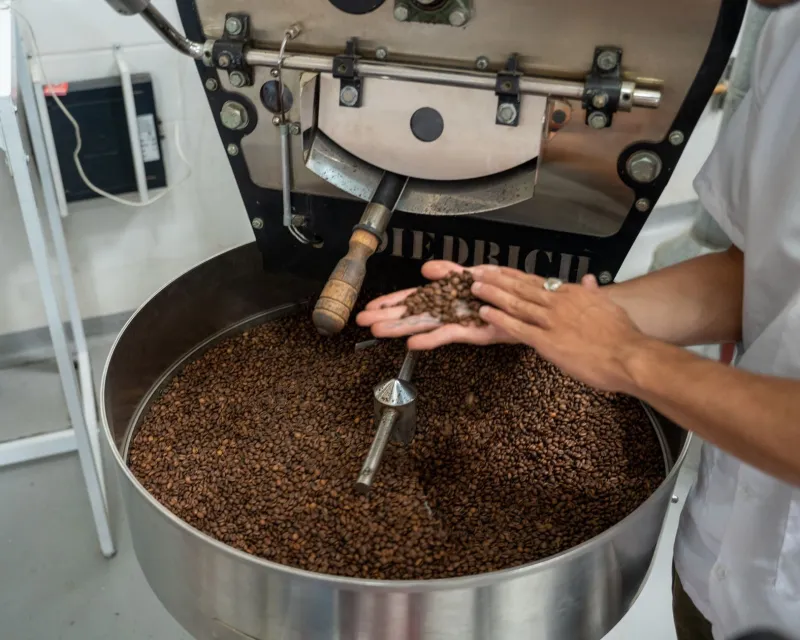
This dialogue also extends to roast development. A blend intended for espresso preparation will benefit from a roast profile that develops sweetness and reduces sharp acidity under pressure. The same origins roasted for a filter preparation might be treated with greater restraint, preserving delicate aromatics that would otherwise be lost in the extraction dynamics of an espresso machine.
Communicating your intended brew method is, therefore, not a minor detail — it is a fundamental variable in the blend's ultimate expression.
Refining Over Time
A personal blend is rarely perfected in a single attempt. It evolves. As your palate develops, as your brewing technique matures, and as the seasons shift your mood and your rituals, so too will your ideal cup. What felt perfectly balanced in January may seem one-dimensional by April. This is not failure — it is growth.
Approach each iteration as a refinement rather than a correction. Document your adjustments with the same care a winemaker applies to vintage notes. Over time, you will accumulate a record of your own sensory development — a portrait of your taste that is as revealing as any journal.
The personal blend, at its finest, is a living document. It speaks to where you have been as a coffee enthusiast and points toward where your curiosity is taking you next.
The Reward of Authorship
There is something profoundly satisfying about lifting a cup and knowing that its contents reflect a series of deliberate, informed choices — that the flavors meeting your palate are not simply what was available, but what you specifically sought. This is the Fusion 20 principle at its most intimate: that extraordinary coffee is not merely found, but created through engagement, knowledge, and a refined sense of self.
Your journey through origins, ratios, and roast profiles is not a detour from the pleasure of coffee. It is the deepest expression of it.