The Ritual Is the Point: Why Premium Beans Fail Without a Premium Process
There is a particular frustration known to those who take coffee seriously. You have sourced an exceptional bag—perhaps a Panama Geisha, a Yemeni Mocha, or a rare natural-process Ethiopian lot. You have spent more than you would typically spend. You have followed the general instructions, used a quality brewer, and waited with genuine anticipation. And yet the cup, while pleasant, does not justify the investment. Something is missing. The complexity you were promised never quite materializes.
This experience is more common than the specialty coffee industry tends to acknowledge, and it is almost never the fault of the bean.
At Fusion 20 Luxury Beans, we hold a foundational belief: extraordinary coffee is not purchased—it is constructed. The bean is the raw material. The ritual is the craft. And the gap between a merely expensive cup and a genuinely transcendent one is defined almost entirely by the variables that most home brewers treat as afterthoughts.
The Myth of the Self-Sufficient Bean
The premium coffee market has cultivated, perhaps unintentionally, a consumer culture that places all responsibility on origin and processing. Purchase the right bag, the logic goes, and the cup takes care of itself. This is a comforting narrative, but it is not accurate.
A Geisha varietal grown at 1,800 meters in Panama's Chiriquí highlands carries within it a remarkable genetic and environmental heritage. Its jasmine aromatics, bergamot citrus, and tea-like delicacy are real and verifiable. But those qualities exist as potential—a code waiting to be read correctly. Brew that same coffee with chlorinated municipal tap water at an imprecise temperature through an inconsistent grind, and the code is scrambled. What arrives in the cup is a flattened, muted approximation of what the bean was capable of offering.
The bean cannot advocate for itself. That responsibility belongs to the person holding the kettle.
Water: The Variable That Changes Everything
Water constitutes approximately 98 percent of a brewed cup of coffee. It is, by volume, the primary ingredient. Yet the vast majority of home brewers in the United States treat water as a neutral carrier—something that simply transports flavor rather than actively shaping it.
This assumption is incorrect, and it is one of the most consequential errors in home brewing.
The Specialty Coffee Association recommends brewing water with a total dissolved solids (TDS) count between 75 and 250 parts per million, with a target of approximately 150 ppm. The mineral composition matters considerably: magnesium ions are particularly effective at binding to and extracting aromatic compounds in coffee, while calcium contributes to body and mouthfeel. Water that is too soft—common in many Pacific Northwest municipalities—will produce a flat, lifeless extraction. Water that is too hard, as is frequently the case in cities like Phoenix or Las Vegas, will create a chalky, over-extracted bitterness that no amount of technique can fully correct.
For the American home brewer investing in genuinely rare beans, the solution is not complicated, but it does require intention. Third-wave water products—pre-formulated mineral packets designed to be added to distilled water—allow complete control over mineral composition. Alternatively, a quality reverse osmosis system paired with a remineralization filter represents a more permanent solution. Either approach transforms water from a passive medium into an active brewing partner.
Chlorine and chloramine, present in virtually all US municipal tap water, are equally problematic. Both compounds interact with coffee's aromatic compounds through oxidation, dulling floral and fruit-forward notes with particular severity. Activated carbon filtration removes chlorine effectively; chloramine requires either a catalytic carbon filter or a brief exposure to campden tablets (potassium metabisulfite) if you are drawing from a filtered pitcher. These are small steps. Their impact on cup quality is not small.
Grind Consistency: The Overlooked Architecture of Extraction
Every coffee professional understands that grind consistency is foundational. The challenge is that this knowledge rarely translates into consumer behavior with the clarity it deserves.
Coffee extraction operates on a simple principle: surface area determines rate of extraction. Finer particles extract faster; coarser particles extract more slowly. When a grinder produces an inconsistent grind—meaning the distribution of particle sizes is wide rather than narrow—the resulting brew contains simultaneously over-extracted fine particles (contributing bitterness) and under-extracted coarse particles (contributing sourness and hollowness). The cup tastes muddled, confused, and unresolved, regardless of how exceptional the bean.
Blade grinders, which chop rather than grind, are categorically unsuitable for premium coffee. They produce an erratic particle distribution that makes consistent extraction essentially impossible. Even entry-level burr grinders represent a significant improvement, but for rare and expensive beans, the investment in a quality flat or conical burr grinder is not optional—it is the price of admission to genuine extraction control.
For pour-over methods, which are particularly well-suited to delicate, complex beans like Geisha or Ethiopian Wush Wush, a grinder capable of precise, repeatable adjustment is essential. The difference between a grind setting that is two clicks too fine and two clicks too coarse can be the difference between a cup that reveals a bean's full aromatic architecture and one that obscures it entirely.
The recommendation at Fusion 20 Luxury Beans is straightforward: invest in your grinder at least as seriously as you invest in your beans. A $50 bag of rare coffee brewed through a blade grinder is a $50 exercise in disappointment.
Temperature Precision: The Discipline of Degrees
The enzymatic and chemical reactions that constitute coffee extraction are acutely sensitive to temperature. The SCA's recommended brewing temperature range of 195°F to 205°F (90.5°C to 96°C) is not an approximation—it is a precision window that matters.
Water boiled and poured immediately from a standard kettle in most US kitchens sits at or near 212°F at sea level—too hot for most specialty applications, particularly light-roasted beans where higher temperatures can accelerate the extraction of harsh, astringent compounds. Conversely, water that has been allowed to cool too long, or a kettle that was never brought to a full boil, may fall below the extraction threshold, producing a sour, underdeveloped cup.
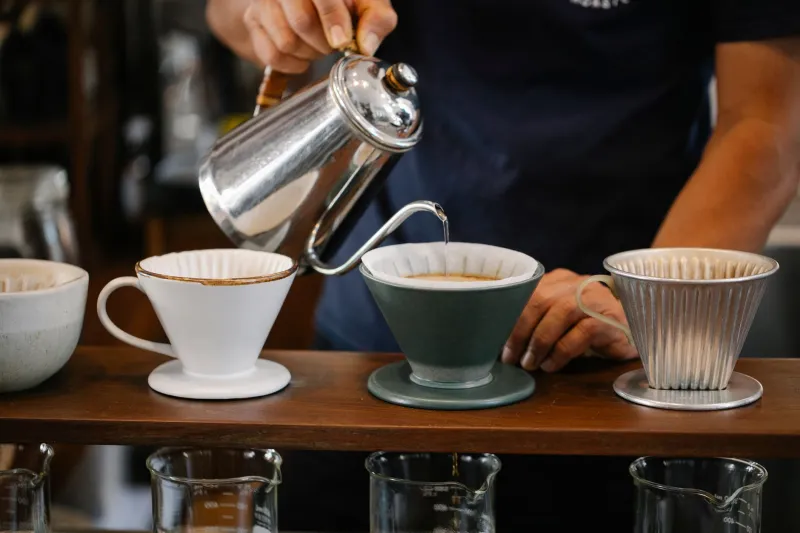
Variable-temperature gooseneck kettles have become one of the most meaningful tools available to the serious home brewer. They allow the user to set a precise target temperature and maintain it throughout the pour—a consistency that is impossible to achieve with a standard stovetop kettle and intuition. For a bean that cost $80 per pound, a $150 temperature-controlled kettle is not an extravagance. It is a logical protection of the investment already made.
Altitude is also a consideration that American brewers outside of coastal cities should account for. Water boils at approximately 202°F in Denver and 194°F in parts of the Rocky Mountain West. At these elevations, brewing at "just off the boil" actually falls at the lower boundary of the recommended range—a detail that can subtly flatten extraction if unaddressed.
Ratios, Timing, and the Discipline of Repetition
Beyond water, grind, and temperature, the remaining variables—coffee-to-water ratio, bloom time, pour cadence, and total brew duration—reward those who approach them with the same discipline a chef applies to mise en place.
A standard starting ratio of 1:15 (one gram of coffee to fifteen grams of water) provides a reliable baseline for most filter methods, but rare and complex beans often benefit from slight adjustments. A lighter ratio of 1:16 or 1:17 can allow more nuanced aromatic compounds to express themselves without the density that masks subtlety. A bloom—allowing freshly ground coffee to degas with a small amount of hot water for thirty to forty-five seconds before the main pour—is particularly important for recently roasted beans, where trapped carbon dioxide can disrupt even extraction.
Precision here does not require obsession. It requires a kitchen scale, a timer, and the willingness to take notes. The brewer who records their variables and adjusts methodically will, within a few attempts, unlock a level of consistency that transforms the experience of rare coffee from occasional brilliance to reliable excellence.
The Philosophy of the Worthy Cup
There is a reason Fusion 20 Luxury Beans frames its mission around extraordinary moments rather than extraordinary products. The product—the bean—is the beginning of the story, not its conclusion. The moment arrives when craft meets quality: when water of the right mineral composition meets a precisely ground, freshly roasted bean at an exact temperature, poured with intention into a clean vessel.
That moment is not purchased at checkout. It is built, deliberately, through the accumulation of correct decisions. The rare bean you have sourced deserves nothing less than the full expression of its potential. The ritual, approached with the seriousness it warrants, is how that potential is honored.