Catalysts in the Cup: How Exotic Spices, Botanicals, and Umami Elements Are Redefining the Specialty Coffee Experience
For decades, the orthodoxy of specialty coffee has rested on a single, almost sacred premise: the bean speaks for itself. Terroir, processing method, and roast profile were considered sufficient variables—any external addition was viewed as an intrusion, a concession to commercial palates that lacked the sophistication to appreciate coffee in its purest form. That orthodoxy is now under quiet but forceful revision.
Across the United States, a cohort of forward-thinking roasters, flavor chemists, and culinary innovators is exploring what happens when carefully selected flavor catalysts—exotic spices, aromatic botanicals, fermented ingredients, even umami-rich compounds—are introduced not to mask a coffee's origin character, but to illuminate it. The discipline, still nascent and without a universally accepted name, is drawing comparisons to the craft cocktail movement of the early 2000s: a moment when bartenders stopped apologizing for complexity and began treating the glass as a canvas for serious culinary expression.
At Fusion 20 Luxury Beans, this philosophy is not merely an academic curiosity. It is, in many ways, the animating spirit behind our approach to sourcing and education. Understanding how flavor catalysts interact with rare and exotic beans is, we believe, the next essential literacy for the discerning coffee enthusiast.
The Science of Synergy: Why Some Pairings Sing and Others Clash
To understand why certain adjuncts elevate a specialty coffee while others flatten or distort it, one must begin with the chemistry of flavor perception. Coffee is among the most chemically complex beverages consumed by humans, containing upward of one thousand distinct volatile aroma compounds. Many of these compounds exist in concentrations too subtle for the palate to register independently—yet they become perceptible, even dominant, when the right catalyst is introduced.
Dr. Arielle Fontaine, a sensory scientist based in Portland, Oregon, who consults with several Pacific Northwest roasters, describes the phenomenon as "aroma bridging." "Certain spices share key aromatic compounds with specific coffee varietals," she explains. "When you introduce cardamom alongside an Ethiopian Yirgacheffe, you are not adding a foreign element—you are essentially amplifying a floral, citrus-adjacent quality that was already present in the bean. The spice acts as a magnifying lens."
This concept of shared volatile compounds is central to the fusion framework. Cardamom and Yirgacheffe both carry linalool, a terpene associated with floral and slightly citrusy notes. Star anise shares trans-anethole characteristics with certain naturally processed Sumatran coffees, reinforcing their inherent earthiness without overwhelming it. Sichuan peppercorn, with its distinctive hydroxy-alpha-sanshool compound, can heighten the perceived brightness of a washed Kenyan AA, creating a tingling, effervescent quality that extends the finish considerably.
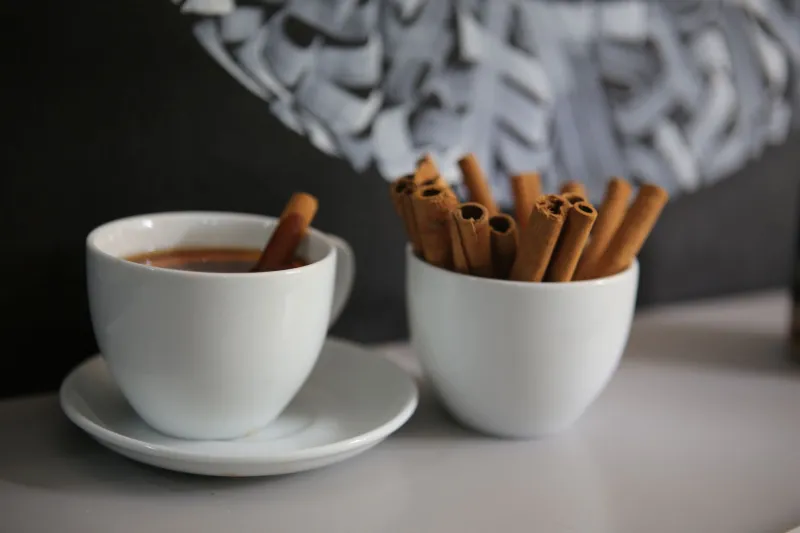
The inverse, however, is equally instructive. Pairings that introduce competing or masking compounds—cinnamon with a delicate Panamanian Geisha, for instance—tend to produce discord. Cinnamon's cinnamaldehyde is aggressive and linear, and it has a documented tendency to suppress the perception of subtle jasmine and stone fruit notes that define the Geisha's celebrated profile. The result is not complexity; it is erasure.
Botanical Frontiers: Beyond the Familiar Spice Rack
While cardamom and cinnamon represent the familiar end of the adjunct spectrum, the more adventurous practitioners in this space are reaching considerably further. Roasters in cities such as Los Angeles, New York, and Chicago are experimenting with ingredients that most American consumers would not associate with a coffee context.
Lavender, long confined to desserts and aromatherapy, has emerged as a compelling companion to medium-roasted Colombian single-origins, where its linalool and camphor notes mirror the bean's own herbaceous undertones. Culinary-grade rose petals—particularly varieties from Iran and Bulgaria, where essential oil concentration is highest—have demonstrated an ability to deepen the perceived sweetness of a naturally processed Brazilian Cerrado without introducing any actual sugar.
Perhaps the most surprising frontier involves umami-adjacent ingredients. Roasters working with Japanese culinary traditions have begun introducing trace amounts of kombu (dried kelp) or shiitake mushroom powder into cold brew preparations. The glutamates present in these ingredients interact with the chlorogenic acids in coffee to produce what sensory scientists call "mouthfeel extension"—a lingering, savory depth that transforms a cold brew from a refreshing beverage into something approaching a gastronomic experience.
Marco Delgado, head roaster at a boutique operation in Brooklyn that sources exclusively from micro-lots in Central and South America, has been refining his umami cold brew program for two years. "The first time I tasted it, I genuinely could not identify what I was perceiving," he recalls. "It wasn't savory in any obvious way. It was more like the coffee had acquired a third dimension—a quality that made you want to keep drinking not because of caffeine or sweetness, but because the flavor kept evolving on the palate."
A Framework for Home Experimentation
For the home enthusiast eager to explore this territory responsibly, a structured approach is essential. Improvisation without a guiding framework tends to produce muddled results and, perhaps worse, can lead one to abandon a promising direction prematurely after a single unsuccessful attempt.
Begin by identifying the dominant flavor notes in the bean you intend to work with. Consult the tasting notes provided by your roaster, and if possible, taste the coffee in its unadorned form several times before introducing any adjunct. This baseline familiarity is non-negotiable.
Next, research the primary volatile compounds associated with your intended catalyst. Several open-access flavor chemistry databases, including the Volatile Compounds in Food database maintained by European researchers, are accessible to non-specialists and provide compound-level information for hundreds of spices and botanicals. Cross-reference these compounds with the known chemistry of your coffee's varietal and processing method.
When introducing the adjunct, do so with restraint. In most cases, the appropriate quantity is far smaller than intuition suggests. A single green cardamom pod, lightly cracked and placed in a French press before brewing, is sufficient for a 12-ounce preparation. A quarter teaspoon of food-grade culinary lavender added to a pour-over bloom phase can be transformative; a full teaspoon will produce something closer to soap.
Document your experiments meticulously. Note the bean origin, roast date, grind size, water temperature, adjunct quantity, and your sensory observations at thirty seconds, two minutes, and five minutes after the first sip. Flavor perception in a catalyzed coffee often shifts significantly as the cup cools, and some of the most interesting qualities emerge in the final third of the drink.
The Integrity Question
Not everyone in the specialty coffee community has embraced this direction with enthusiasm. Purists argue, not without merit, that the addition of any external ingredient risks obscuring the very qualities that justify the premium price of a rare single-origin bean. If a Geisha from Boquete, Panama commands a significant premium because of its terroir-driven complexity, what does it mean to alter that complexity deliberately?
It is a fair question, and one that the most thoughtful practitioners in this space take seriously. The answer, as Dr. Fontaine and roasters like Delgado consistently emphasize, lies in intention. The goal of responsible flavor fusion is never to substitute for origin character, but to serve as a lens—to render visible what was already present in the bean, and to invite the drinker into a more active, more curious relationship with the cup.
At Fusion 20 Luxury Beans, we regard this emerging discipline as entirely consistent with our foundational belief that extraordinary moments are not accidents. They are the product of knowledge, curiosity, and a willingness to look beyond convention. The bean remains sovereign. The catalyst, at its best, is simply the light by which its full complexity becomes visible.