The Art of Reading a Bean: How Sommelier Methodology Is Transforming the Way We Select Specialty Coffee
The Master Sommelier examination is widely regarded as one of the most demanding credentialing processes in the food and beverage world. Candidates must demonstrate not only encyclopedic knowledge of wine regions, vintages, and varietals, but also the capacity to identify a wine's origin, producer, and approximate year through sensory analysis alone—blind. The rigor is extraordinary. And increasingly, specialty coffee professionals are asking a quiet but consequential question: what would happen if we applied this same standard of disciplined attention to the bean?
The answer, it turns out, is transformative.
The Shared Architecture of Sensory Evaluation
At first glance, wine and coffee occupy distinct sensory territories. Wine is liquid from the vine, aged in vessel, shaped by vintage. Coffee is a roasted seed, brewed through water, shaped by processing and heat. The differences are real. But the underlying architecture of professional sensory evaluation translates with surprising fidelity.
Both disciplines begin with a structured approach to aroma. In wine, this is divided between the primary aromas arising from the grape itself, secondary aromas introduced by fermentation, and tertiary aromas developed through aging. Coffee professionals working within a sommelier-adjacent framework apply a parallel logic: origin-derived aromatics (the florality of a Kenyan Nyeri, the dark fruit of an Ethiopian Guji), processing-derived notes (the fermented sweetness of a natural, the clean brightness of a washed lot), and roast-derived compounds (caramelization, Maillard reaction products, the development of smoky or nutty tones in darker profiles).
This layered reading of aroma alone—before the first sip—already constitutes a more sophisticated engagement with coffee than most enthusiasts practice.
Flavor Mapping as a Practical Tool
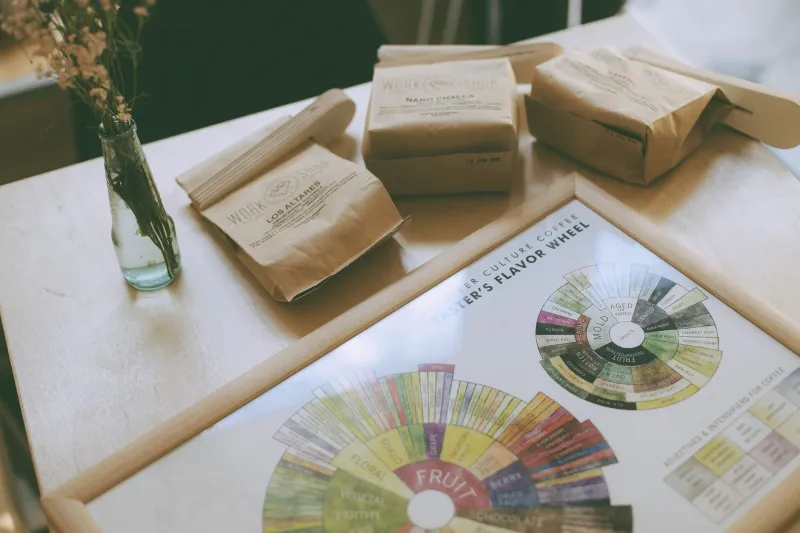
Sommeliers use flavor maps as cognitive scaffolding: structured mental frameworks that allow them to organize sensory impressions quickly and communicate them with precision. The Specialty Coffee Association's Flavor Wheel, introduced in its modern form in 2016, performs an analogous function for coffee—but many professionals argue that it is most useful when treated not as a checklist but as a map.
The distinction matters. Checking off "citrus" and "chocolate" on a flavor wheel is a passive act. Mapping the relationship between those notes—understanding that the citrus is arriving at the front of the palate, that it is sharp rather than round, that it fades before the mid-palate where a milk chocolate quality emerges and lingers through the finish—is an active, analytical engagement that reveals far more about the bean's character and the roaster's intentions.
For the home enthusiast seeking to adopt this approach, the practice begins with slowing down. Tasting coffee the way a sommelier tastes wine requires the elimination of distraction, the use of a clean palate, and a willingness to sit with a cup through its full temperature arc. A premium bean at one hundred and sixty degrees Fahrenheit will taste materially different at one hundred and twenty degrees—and the progression itself is data.
Terroir Analysis: From the Vineyard to the Farm
Perhaps the most intellectually rich crossover between wine and coffee evaluation is the concept of terroir—the idea that a product carries within it the indelible imprint of the specific place where it was grown. In wine, terroir encompasses soil composition, topography, microclimate, and even the cultural practices of the farming community. In coffee, the parallel concept is equally robust.
A Gesha varietal grown at eighteen hundred meters in Panama's Boquete highlands will express itself differently than the same varietal grown at comparable elevation in Ethiopia's Bench Maji zone. The volcanic mineral content of the soil, the pattern of rainfall, the diurnal temperature range—all of these leave traceable signatures in the cup. A taster trained to read terroir in coffee can begin to identify not just country of origin but specific growing region, and in some cases, specific farm.
This level of literacy does not develop overnight. But it is achievable through deliberate practice, and the path is well-mapped. Tasting the same varietal across multiple origins side by side—a technique borrowed directly from comparative wine evaluation—is one of the most efficient methods of developing terroir sensitivity. It removes the variable of the bean's genetic identity and isolates the environmental and processing influences, making the distinctions between origins perceptible even to a relatively inexperienced palate.
Structured Pairing as a Selection Strategy
Sommeliers are trained to think about wine not in isolation but in relation—to food, to occasion, to the diner's palate preferences. This relational thinking is among the most transferable elements of the sommelier methodology for coffee enthusiasts.
Selecting a bean for a specific pairing context requires a different evaluative lens than selecting a bean for solitary enjoyment. A high-acidity washed Ethiopian might pair brilliantly with a citrus-forward pastry but overwhelm a delicate almond croissant. A low-acid, full-bodied Sumatran natural might anchor a pairing with dark chocolate or aged cheese in a way that a lighter roast cannot. Understanding these dynamics—and selecting beans accordingly—elevates coffee from a morning ritual to a considered element of a complete sensory experience.
For American enthusiasts who have already developed sophisticated palates through exposure to fine dining, craft spirits, and artisanal cheese, this pairing-oriented approach to bean selection will feel intuitive. It is, in essence, the same curatorial intelligence applied to a new medium.
Adopting the Framework at Home
The transition from casual coffee drinker to sensory sommelier does not require formal certification. It requires three things: quality source material, structured practice, and a willingness to develop a personal tasting vocabulary.
Begin by sourcing beans from a single producer across multiple processing methods—a washed, a natural, and a honey process from the same farm, if possible. Brew each identically, taste them side by side, and document your impressions using the layered aroma-flavor-finish structure borrowed from wine evaluation. Note what changes and what remains consistent. The consistency is the terroir speaking. The variation is the process.
Over time, this practice builds a sensory archive—a personal reference library of impressions, comparisons, and preferences that makes future bean selection far more precise and far more rewarding.
At Fusion 20 Luxury Beans, we believe that the finest beans in the world deserve the finest attention. The sommelier's methodology, applied to coffee, is not pretension. It is respect—for the farmer, the roaster, and the extraordinary complexity that arrives in every well-sourced cup.